( no. 014 ) ( against the grain ) ( english )
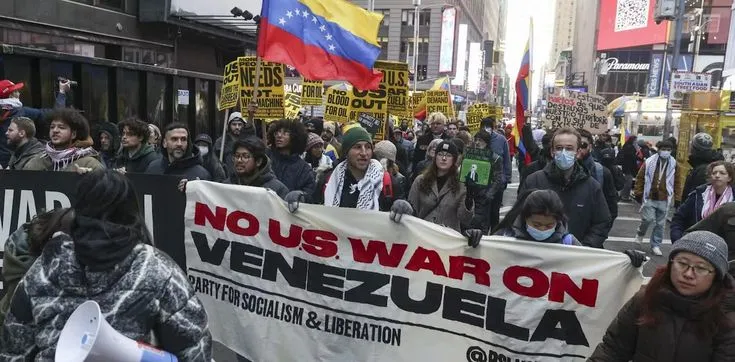
the past few days have made it impossible to talk about venezuela in abstractions alone. the arrest of nicolás maduro by the united states framed as a law‑enforcement operation, executed like a military intervention has pushed what was already implicit into full view. sovereignty was not debated, it was overridden. legality was narrated after the fact that power moved first, language followed.
this is what empire looks like now. not always invasion in its most cinematic form, but the confident ability to reach into another nation, extract its head of state, and relocate the entire political conversation onto american terms. the arrest is being discussed as justice, as accountability, as necessity. but those words feel thin when held against the scale of what it represents: a superpower asserting that its jurisdiction exceeds borders when it decides it must.
venezuela is once again being positioned as evidence. proof that certain political arrangements are illegitimate, that instability authorizes intervention, that sovereignty is conditional. america appears not as aggressor but as administrator, stepping in to correct disorder. this framing depends on forgetting history. it depends on treating venezuela’s crisis as self‑contained rather than shaped, intensified, and prolonged by external pressure.
sanctions, financial isolation, and diplomatic interference have long been justified as nonviolent alternatives to war. but economic warfare is still warfare. it reorganizes access to food, medicine, infrastructure, and survival itself. when a state is systematically weakened and then declared ungovernable, the conclusion feels rehearsed. intervention begins to look inevitable because the conditions for collapse were carefully cultivated.
this is where fascism becomes harder to name. it no longer relies on spectacle or explicit authoritarian aesthetics. it operates through administration, through policy, through the quiet assumption that some populations can be subjected to prolonged suffering for the sake of order or moral clarity. fascism here is procedural. it files reports. it cites legality while dismantling autonomy.
the arrest of maduro crystallizes this logic. it is being defended as exceptional, as justified by criminal charges, as detached from broader political strategy. but exceptions are where power reveals itself most clearly. when one country claims the authority to decide which leaders are removable and which nations are governable, hierarchy is no longer implicit. it is operational.
venezuela’s refusal to fully align with american economic and political interests has consistently been framed as incompetence or tyranny, never as resistance. sovereignty is tolerated only when it does not disrupt imperial arrangements. when it does, punishment is reframed as protection, and coercion is renamed responsibility.
what makes this moment especially unsettling is how normalized it feels. how quickly the language of law absorbs the reality of force. how easily a military extraction becomes a courtroom story. violence does not disappear in this translation. it is simply laundered through institutions familiar enough to feel legitimate.
this pattern extends far beyond venezuela. across latin america and the global south, political deviation is met with pressure, destabilization, and eventual justification for intervention. instability is treated as evidence of failure rather than the predictable result of sustained interference. cause and consequence collapse until empire appears reactive rather than directive.
there is also a deliberate narrowing of critique. to question american action is framed as endorsement of authoritarianism. to insist on sovereignty is treated as moral naivety. this false binary does important work. it keeps attention away from the structure itself. it demands alignment rather than analysis.
what continues to unsettle me is how easily the language of freedom accommodates this violence. how fascistic control survives inside liberal vocabulary. freedom becomes conditional. democracy becomes selective. legality becomes something invoked after power has already spoken.
writing about venezuela now is not about defending a government or denying internal harm. it is about refusing the comfort of clean narratives. it is about naming how empire sustains itself through policy, finance, and the authority to decide whose suffering is acceptable.
fascism no longer needs to announce itself loudly. it survives quietly, inside procedures, inside sanctions regimes, inside the assumption that some lives are more expendable than others. if there is anything worth remaining attentive to, it is when intervention is explained calmly, legally, and at length, it has usually already been rehearsed